Future Forms: New Methods, Familiar Matter
Futurism in 20th-century architecture was obsessed with lightweight metals, plastic domes, and glass towers that required endless air conditioning to remain habitable. In the 21st century, genuine avant-garde design has pivoted 180 degrees. The future is heavy, biological, mineral, and algorithmic. By directing robotic fabrication tools toward unbaked earth, raw stone blocks, and un-glued timber, architecture achieves structural geometries once deemed impossible.
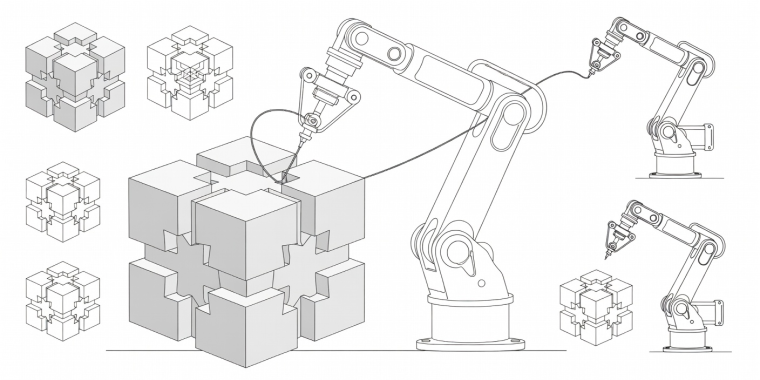
Robotic Stereotomy and Topological Optimization
Traditional masonry was constrained by planar cuts and orthogonal tooling. With multi-axis robotic wire sawing, stone can be carved into complex ruled surfaces and doubly curved voussoirs. Through finite element topological optimization, algorithms strip away mass from where stress is zero, creating bone-like stone skeletons that reduce self-weight by up to 45% while preserving compressive safety factors.
These components do not require structural mortar. Instead, precision-milled shear keys slot together like giant geological puzzles, absorbing wind vibrations through dynamic friction.
Continuous Robotic Earth Printing (3D Mud Extrusion)
The primary historical constraint of rammed earth construction was formwork: heavy plywood or steel shutters had to be erected, braced, and dismantled for every running meter of wall. 3D mud printing completely eliminates formwork.
Using localized soil, agricultural fiber waste (such as hemp straw), and natural hydraulic binders, robotic crane printers deposit self-supporting corbelled geometries, honeycomb interior insulation voids, and integrated conduit tracks in a continuous spiral deposition process. The resultant envelopes feature organic curvature dictated by structural wind-shedding physics.
Speculative Systems Assessment
| Emerging Paradigm | Technological Driver | Current Scalability Limit | Primary Regulatory Barrier |
|---|---|---|---|
| Robotic Dry-Stone Vaulting | Parametric force density algorithms | High quarry setup costs | Eurocode 6 lack of non-mortar standards |
| On-Site Soil 3D Printing | Continuous paste delivery pumps | Weather-dependent curing speeds | Seismic load certification under ASTM |
| Structural Mycelium Blocks | Fungal hyphae biomass colonization | Low compressive capacity (< 2 MPa) | Long-term moisture degradation risk |
| Friction-Welded Hardwood Joints | High-frequency vibrational friction | Component geometry limitations | Lack of empirical fire endurance tables |
Separating Science from Speculative Rendering
The internet is inundated with photorealistic AI renders of fantastical buildings overgrown with tropical jungle vines or floating stone sky-bridges. As architectural critics, we insist on separating digital fantasy from physical fabrication. A structure is not sustainable because an AI prompt depicted it with tree branches; it is sustainable only if its structural loads, supply chain carbon, and moisture dynamics withstand thermodynamic scrutiny in the physical world.