Natural Systems: Building with Earth and Timber
Earth and timber constitute humanity's oldest continuous building systems. Over the last decade, both materials have been re-engineered through precision industrial processing. Yet their ecological promises are frequently compromised by unexamined chemical stabilization and synthetic bonding agents. An architectural critique must discern where natural systems retain true circularity and where they merely masquerade as sustainable.
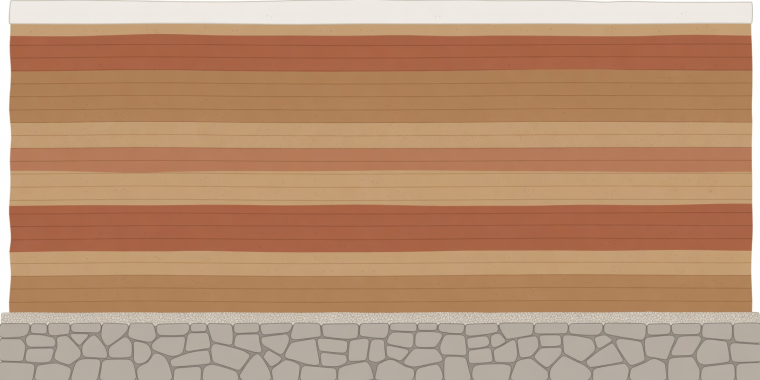
The Great Stabilization Compromise: Unfired Earth vs CSRE
Authentic rammed earth relies on granular friction, precise gravel-to-clay ratios, and hydraulic compaction. When properly shielded with generous eaves ("a good hat and good boots"), unstabilized earth can stand for centuries while remaining 100% recyclable: when the building reaches end-of-life, the wall can literally be returned to agricultural fields as soil.
In contrast, modern commercial building codes frequently mandate "Cement-Stabilized Rammed Earth" (CSRE), blending 6% to 10% ordinary Portland cement into the mix. This practice ruins both circularity and permeability: the wall can no longer break down naturally, its embodied energy spikes dramatically, and its hygroscopic vapor-buffering capacity drops by up to 60%. True structural progress lies not in poisoning earth with cement, but in engineering proper physical drainage and microclimate orientation.
Timber Without Petrochemicals: The DLT Shift
Mass timber is hailed as the low-carbon savior of mid-rise urban development. However, standard Cross-Laminated Timber (CLT) panels consume vast quantities of synthetic polyurethane and melamine resins. These glues impede off-gassing and turn demolition timber into hazardous incinerator feed rather than compostable cellulose.
Dowel-Laminated Timber (DLT) provides the honest alternative. Timber boards are stacked on edge and secured solely using kiln-dried hardwood dowels. As the dowels absorb ambient moisture post-assembly, they expand within the softwood lamellas, locking the panels together through natural mechanical friction. No glues, no formaldehyde, zero petrochemical VOCs.
Comparative System Mechanics
| System | Vapor Permeability | Seismic Dissipation Mode | Fire Resistance Mechanic |
|---|---|---|---|
| Unstabilized Pisé (Rammed Earth) | High (μ = 5–10) | Mass dampening and shear friction | Completely non-combustible (Class A1) |
| Light Straw-Clay Envelopes | Extreme (μ = 2–4) | Timber subframe flexibility | Self-insulating char layer; oxygen starvation |
| Dowel Mass Timber (DLT) | Moderate (μ = 20–40) | Inter-panel dowel yielding | Predictable charring rate (0.65 mm/min) |
Rethinking Durability: Weathering as Expression
Industrial architecture demands static surfaces that resist weathering until they suddenly fail and require landfill replacement. Earth and untreated timber operate on an evolutionary lifecycle. An untreated larch rain-screen silvers over five winters, developing a self-protecting tannin patina. A lime-washed earth wall micro-erodes and accepts annual recoating as ritual maintenance rather than catastrophic structural decay.