Interiors: Rooms Shaped by Material
The typical commercial interior is an exercise in rapid obsolescence: gypsum drywall over metal furring, polyurethane sealants, plastic moldings, and petrochemical emulsion paints. After ten years of commercial leases, the entire assembly is stripped and sent to landfill. In contrast, an interior shaped by raw mineral matter and monolithic earth is an enduring topographic carving that matures with occupancy.
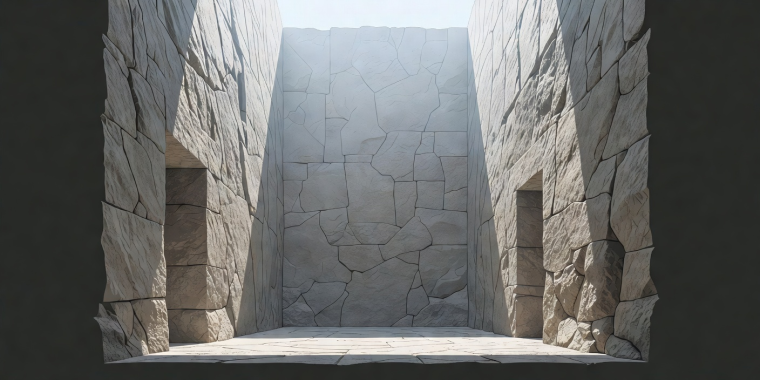
Acoustic Mass: Escaping the Gypsum Drum
Hollow drywall interiors resonate like acoustic drums, transmitting vibrations between rooms while requiring synthetic fiberglass insulation batts to dampen flutter echoes. Solid earth and stone behave entirely differently. Due to their extreme mass and microscopic surface porosity, unpolished travertine, split sandstone, and clay plasters absorb mid-frequency sound waves through viscous air friction within their micro-channels.
Stepping into an interior bounded by 400 mm rammed earth walls delivers an immediate sensory drop in acoustic pressure: conversational clarity sharpens, mechanical duct noise is deadened, and footsteps resonate with grounded solidity rather than hollow hollow clicks.
Microclimate Regulation Through Hygroscopic Surfaces
Interior air quality is dictated by how surfaces interact with humidity. Impervious vinyl paints and sealed lacquers trap airborne moisture until condensation forms, inviting black mold in hidden corners. Pure natural lime and unfired clay plasters are open-pored hygroscopic membranes.
During periods of elevated humidity (cooking, showering, human respiration), these porous surfaces absorb excess water vapor directly into their capillary structures without losing structural integrity. When humidity levels fall, the moisture is slowly evaporated back into the ambient air, maintaining natural indoor humidity equilibrium between 40% and 60% without humidifiers.
Documented Sculptural Interiors
Vals Subterranean Thermal Baths
Designed by Peter Zumthor using 60,000 layered slabs of Valser Quarzite quarry stone, forming cavernous rooms that merge naturally with mineral springs.
Casa de Tierra Gallery Enclave
Curved undulating interior partition ribs formed from unpigmented site-cast earthen loam, creating recessed niches for sculpture without synthetic display plinths.
Monolithic Travertine Chamber
A speculative urban reading room where walls, seating benches, and book shelving are carved from continuous massive blocks of roman travertine.
The Ethics of Surface Honesty
Too many interior schemes utilize artificial distress techniques: acid-washed porcelain tiles mimicking marble, stamped vinyl flooring mimicking oak planks, and fiberglass faux-rock panels mimicking slate. This visual deception hollows out architectural integrity.
An honest natural interior allows stone to be heavy, timber to expand and contract with the seasons, and earth to show the stratified thumbprints of its rammers. Beauty resides in the authentic physics of the room.